

New Report Highlights the Need to Unlock Private Investment to Accelerate the E-Bus Transition
ITDP Logo
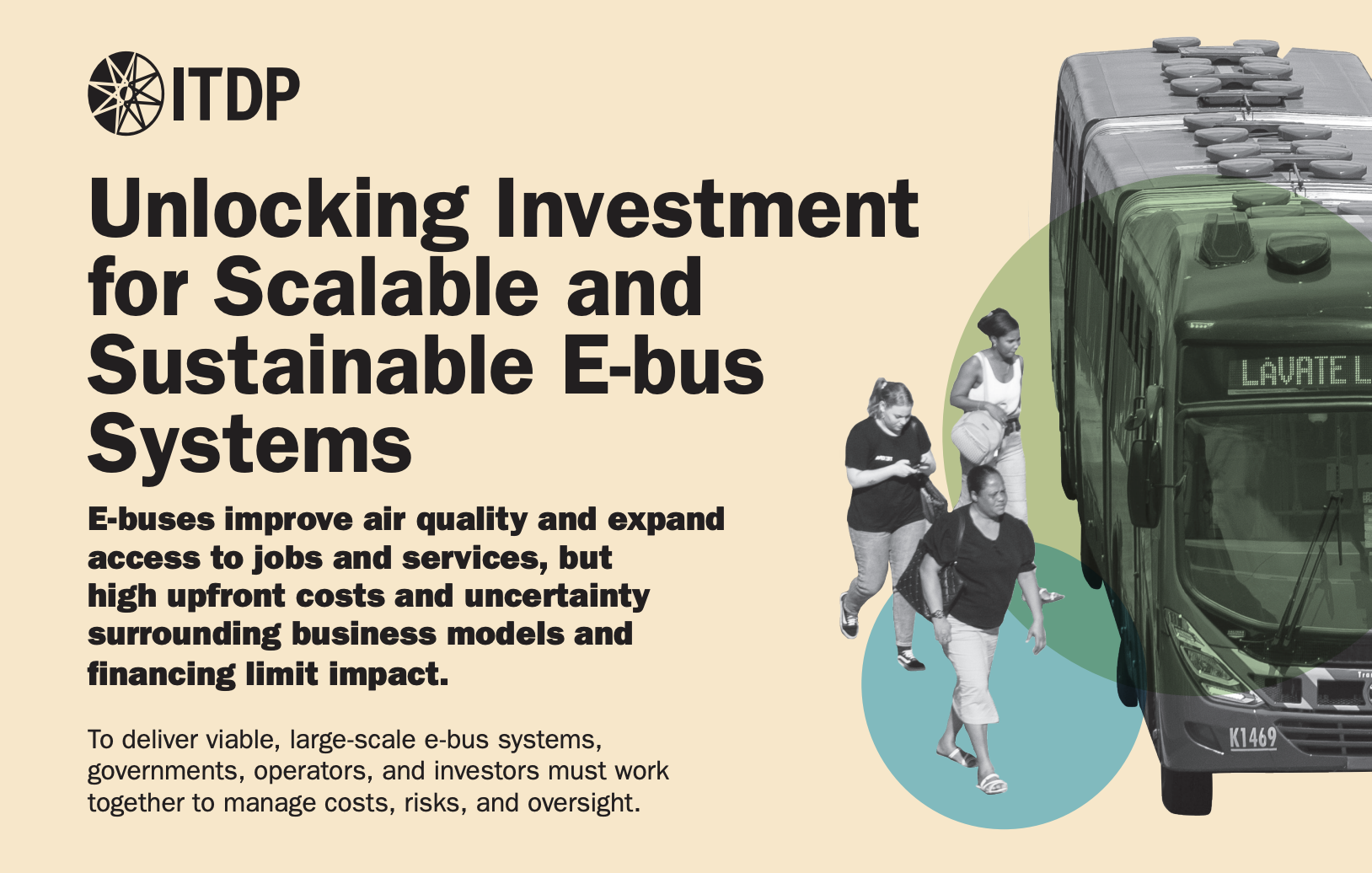
Cover of Financing E-Buses infographic.
A new ITDP report shows that governments can use private capital to finance electric public transport through new business models, financing, and policy tools.
A new report, Financing the E-Bus Transition, from the Institute for Transportation and Development Policy (ITDP) outlines how governments can capitalize on this momentum to scale investment in electric buses, particularly in low- and middle-income countries (LMICs). The roadmap identifies practical steps governments can take to make e-bus projects more attractive to private investors while delivering cleaner, more affordable, and more reliable public transport.
E-buses can improve air quality, reduce greenhouse gas emissions and noise, and improve daily journeys for millions of passengers and drivers. Over their lifetimes, they can also cost cities less to operate than diesel buses, reduce dependence on imported fossil fuels, and help countries conserve foreign currency reserves.
Learning from the Energy Transition
The rapid growth of solar energy offers an important blueprint for accelerating transport electrification. Early government interventions, including feed-in tariffs, production incentives, standardized systems, and other market supports, helped reduce risk and create the conditions for private investment. A similar combination of policy support, financing innovation, and coordinated investment can help electric buses move from individual projects to large-scale deployment.
Innovative financing mechanisms are already creating new opportunities in emerging markets. Leasing, green bonds, pooled procurement, guarantees, and other risk-sharing mechanisms can help governments, operators, manufacturers, financiers, and other private-sector partners share the costs and risks of e-bus investments.
Building Bankable E-Bus Projects
Governments play a central role in creating the conditions needed to attract private capital. This begins with developing strong business models and contracts that clearly allocate responsibilities and risks. Gross cost contracts, for example, let governments pay operators based on kilometers of service delivered while retaining greater control over fares and service planning. These models have helped cities worldwide establish reliable public transport operations while creating clearer revenue structures for private operators and investors. Other approaches, including asset leasing, aggregated procurement, and guarantees, can further reduce upfront costs and distribute financial risks.
Early planning and feasibility work is equally important. Linking e-bus investments to existing transport plans can improve integration and access to funding, while studies of grid capacity, charging infrastructure, and total cost of ownership can help identify and address risks before major investments. Development finance institutions can play an important role by providing grants or other support for this early-stage work, helping projects develop enough to attract loans, blended finance, and private investment.
Government Leadership Is Essential
Private investment will not replace strong public leadership. National and local governments must set clear electrification commitments and create predictable policy environments where investors can operate with confidence. Binding electrification targets, renewable energy policies, supportive tax and trade measures, and timelines for phasing out internal combustion engine vehicles can send powerful signals to investors and manufacturers. Policies that support domestic e-bus production can also strengthen industrial development while creating new economic opportunities.
Political leadership is particularly important. High-level champions, from ministers to mayors, can sustain momentum, coordinate across government agencies, and keep e-bus programs a priority through political transitions. Because transport electrification cuts across multiple sectors, finance, transport, and energy authorities must work together. Designating a central authority with the technical and financial capacity to coordinate implementation can help maintain project momentum and ensure that decisions are aligned across government.
A Moment for Public-Private Collaboration
Growing interest from private investors offers governments an important opportunity to accelerate the transition to clean urban transport. But investors need predictable markets, transparent regulations, and well-prepared projects. Governments can build private-sector confidence by strengthening regulatory frameworks, adopting EV-supportive tax and trade policies, encouraging local manufacturing, and using supply-side measures such as zero-emission vehicle mandates or internal combustion engine phase-out timelines.
The transition to electric public transport will be built through public-private collaboration. Governments must provide leadership and establish the enabling conditions, while private-sector actors bring capital, technology, and innovation. With coordinated action, governments, investors, development finance institutions, and civil society can make e-bus projects more bankable, reduce risks, and accelerate investment in clean, high-quality public transport. The opportunity is clear: electric buses can improve urban liveability, strengthen energy security, and create new investment and industrial opportunities. Now is the time to build the systems that can deliver this transition at scale.
“Cities understand the benefits of e-buses, and private investors are increasingly seeing the opportunity,” said Heather Thompson, ITDP's CEO. “The challenge now is to create the conditions that allow public and private capital to work together. Governments can encourage more investment by providing clearer policies, developing bankable projects, and using proven tools to manage risk.”
###
About the Institute for Transportation and Development Policy
The Institute for Transportation and Development Policy (ITDP) is a global nonprofit organization that designs and implements high-quality transport systems and land-use policies that make cities more sustainable, equitable, and livable. ITDP works with cities and communities worldwide to improve public transport, promote walking and cycling, reduce dependence on private vehicles, and accelerate the transition to zero-emission transportation.
www.itdp.org
Alphonse Tam
Institute for Transportation and Development Policy
alphonse.tam@itdp.org
Visit us on social media:
LinkedIn
Bluesky
Instagram
Facebook
YouTube
X
Other
Legal Disclaimer:
EIN Presswire provides this news content "as is" without warranty of any kind. We do not accept any responsibility or liability for the accuracy, content, images, videos, licenses, completeness, legality, or reliability of the information contained in this article. If you have any complaints or copyright issues related to this article, kindly contact the author above.
