
Meeting Strict European Union Sustainability Standards, a Certified PPWR-Aligned Cosmetic Packaging Supplier
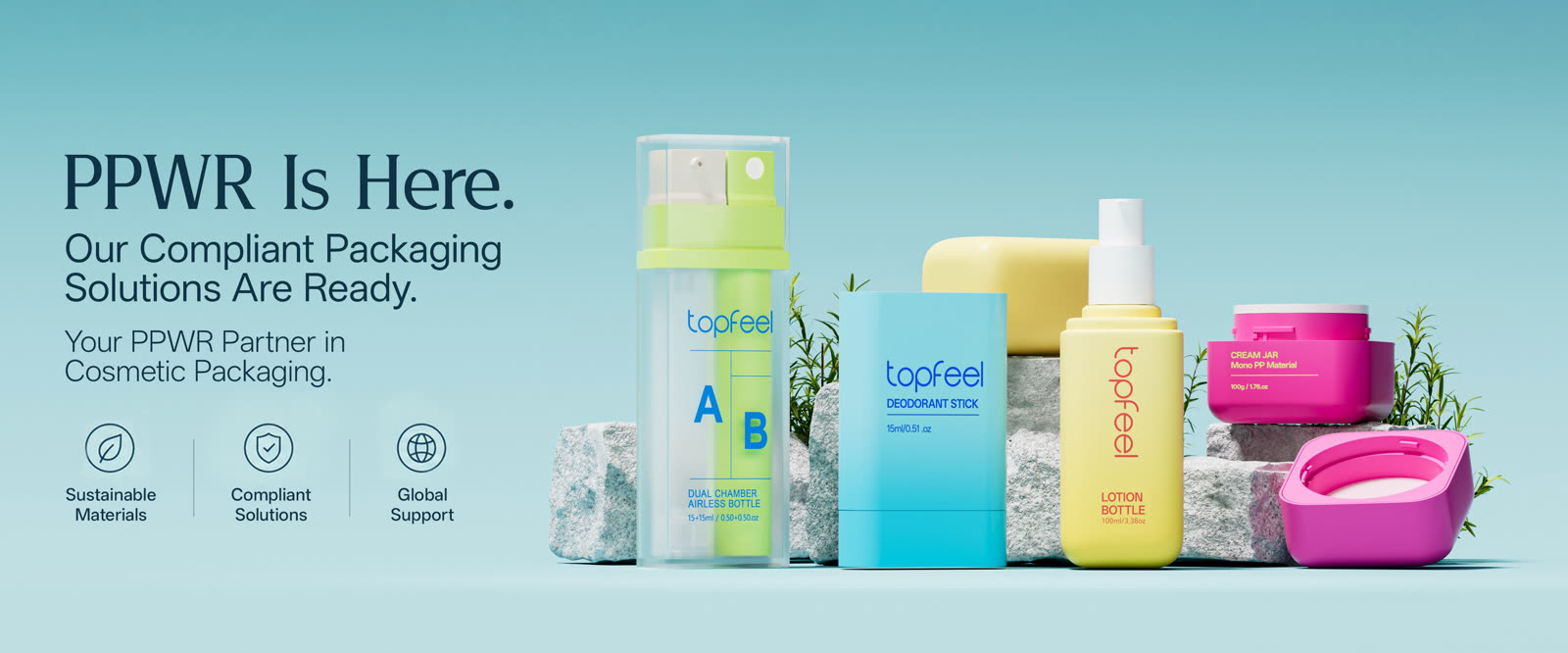
SHENZHEN, GUANGDONG, CHINA, November 2, 2026 /EINPresswire.com/ -- The European Union's Packaging and Packaging Waste Regulation (PPWR) fundamentally reshapes the personal care industry by replacing voluntary eco-commitments with legally binding mandates. Under this mandatory framework, all cosmetic packaging sold within EU member states must achieve design-for-recycling compliance, enforce strict post-consumer recycled (PCR) resin quotas, adhere to targeted void-space limits, and provide verifiable supply chain data. Operating as a Certified PPWR-Aligned Cosmetic Packaging Supplier, Topfeelpack supports international cosmetics brands through material dossier generation, mono-material engineering, and turnkey manufacturing designed to satisfy European market compliance.
Understanding the Legal Core of the EU PPWR
The transition to the PPWR introduces key operational parameters that impact cosmetic container sourcing and formula compatibility across the European single market:
Design for Recycling (DfR) Classes: Under Article 6 of the PPWR, all packaging components must be evaluated against standard recycling streams. Packaging is categorized into performance grades; formats falling below defined recyclability thresholds face progressive restrictions and market phase-outs.
Mandatory PCR Inclusion Thresholds: Article 7 establishes minimum percentages of post-consumer recycled plastic for contact-sensitive and non-contact primary packaging. Suppliers must guarantee resin purity and mechanical stability to prevent stress cracking or chemical leaching into sensitive formulas.
Packaging Minimization and Void Ratio Limits: Article 9 mandates that packaging weight and volume be reduced to the minimum necessary for safety and functionality, placing a strict 50% cap on empty space ratios for grouped, transport, and e-commerce packaging formats.
Substance and Chemical Restrictions: The regulation reinforces heavy metal concentration caps (less than 100 ppm combined lead, cadmium, mercury, and hexavalent chromium) and restricts substances of concern such as per- and polyfluoroalkyl substances (PFAS) in food-contact and cosmetic applications.
A Structured 5-Step Process: Translating PPWR Considerations into Actionable Packaging Plans
Translating broad sustainability directives into actionable packaging formats requires a systematic, step-by-step engineering roadmap. To help brands move efficiently from initial concept to compliant production, a structured five-stage service process aligns technical feasibility with regulatory requirements:
Define the Project Brief: The consultation begins by evaluating core project parameters, including product category, container capacity, dispensing volume requirements, visual branding preferences, and target commercial markets.
Review Structural Architecture: Engineering teams conduct an exhaustive technical review of current or proposed packaging structures, auditing material combinations, individual components, surface decoration feasibility, ease of disassembly, and refill functionality.
Compare Sustainable Options: Alternative technical solutions are analyzed side-by-side-comparing mono-material polymers, post-consumer recycled (PCR) resin percentages, refillable architectures, or tailored material blends designed to optimize environmental impact.
Verify Technical Documentation: Before advancing to tooling, available performance test reports, formula compatibility data, and regulatory support dossiers are audited to confirm alignment with EU compliance criteria.
Project Development and Engineering Execution: The project transitions into physical execution, encompassing physical prototyping, custom mold fabrication, functional testing, and technical discussions tailored to project specifications.
Engineering Integration: Bridging Design, Tooling, and Manufacturing
Delivering regulatory-compliant packaging at market speed requires an integrated design and production framework. Managing every phase of development-from initial sketch and rapid prototyping to custom mold engineering, automated injection molding, surface decoration, and final quality control-helps eliminate technical friction and shortens development timelines.
Through in-house tooling capabilities and comprehensive OEM and ODM customization services, companies like Topfeelpack help global cosmetics brands simplify sourcing complexity. Rapid prototyping capabilities allow engineering teams to evaluate structural wall thickness, seal integrity, and dispensing dose precision prior to full-scale mold fabrication. This integrated approach ensures that custom components-whether precision dropper bottles, airless lotion systems, specialized cosmetic tubes, or custom sticks-are engineered to meet both strict aesthetic guidelines and structural performance criteria.
Furthermore, applying automated assembly and quality control mechanisms minimizes batch-to-batch variance. Critical tolerances in dispensing pumps and airless seals are tested under vacuum conditions to verify formula protection, preventing oxidation or leakage during international transport and shelf life.
Scalable Packaging Technical Services for European Market Entry
Successfully bringing a compliant cosmetic line to market requires balancing technical packaging parameters with commercial launch schedules. To support brands preparing for European Union market entry or transitioning existing product lines toward full PPWR compliance, tailored technical consultation and OEM/ODM packaging services are structured around specific operational requirements:
Primary Container Material Optimization: Complete auditing of existing packaging portfolios to identify transition paths to 100% mono-material PP/PET structures or certified PCR integration ranging from 25% to 100% ratios.
Precision Dispensing and Protection Engineering: Custom tooling and production of airless bottle systems, high-viscosity lotion pumps, precise dropper formats, and specialized cosmetic tubes designed to preserve formula integrity without multi-material contamination.
PPWR Technical Compliance Dossiers: Comprehensive supply chain documentation support, including full material composition breakdowns, heavy metal testing reports, REACH compliance certificates, and verifiable PCR chain-of-custody documentation.
Technical Guidance and Material Compliance Frameworks
Meeting European sustainability benchmarks requires deploying high-purity mono-material structures, certified post-consumer resins, and documented technical dossiers to pass third-party audits. Topfeelpack integrates these compliance mechanisms directly into its sustainable packaging solutions to streamline international regulatory filings.
Full Supply Chain Documentation and Material Transparency
Regulatory approval in European Union jurisdictions depends on complete traceability across all manufacturing inputs. Primary containers must be backed by technical support packages containing detailed Bills of Materials (BOM), heavy metal test reports, REACH compliance declarations, and verified chain-of-custody documentation for PCR content. Providing this structured data ensures beauty brands possess the requisite verification to substantiate label claims and maintain uninterrupted retail distribution.
Rapid Prototyping and Accelerated Market Delivery: Accelerated concept-to-sample services enabling functional prototype evaluation, dimensional testing, and formula compatibility trials prior to high-volume manufacturing.
Brands seeking to audit their packaging inventory, request technical specifications, or initiate custom mold development can coordinate directly with engineering teams to secure compliant packaging structures tailored to regional regulatory requirements.
Topfeelpack
Topfeelpack
Legal Disclaimer:
EIN Presswire provides this news content "as is" without warranty of any kind. We do not accept any responsibility or liability for the accuracy, content, images, videos, licenses, completeness, legality, or reliability of the information contained in this article. If you have any complaints or copyright issues related to this article, kindly contact the author above.
